For Participants โ€” AI Automation Specialist | AI.Deals
For participants, current employees & job seekers

Learn to turn business tasks into automated workflows.

The AI Automation Specialist track teaches practical workplace skills: identify repeated work, map business processes, use AI responsibly, coordinate simple no-code automations, and explain the business value.
4
week structure
Live
labs & practice
1
portfolio project
No
advanced coding required
Stop repeating, start automating with AI
Participant focus
This is for people who want practical AI skills that make them useful inside a real business.
  • โœ“AI prompting for business output
  • โœ“Workflow discovery and process mapping
  • โœ“Forms, sheets, email, CRM, calendar, and task automation concepts
  • โœ“Human review, approval, and responsible AI use
  • โœ“Final workflow map, automation plan, and impact estimate
Quick Examples

Two quick examples. Unlimited possibilities.

These are simple examples of what AI.Deals can build. The real value is taking your business process, your tools, and your daily repetitive work, then turning it into a practical AI workflow.

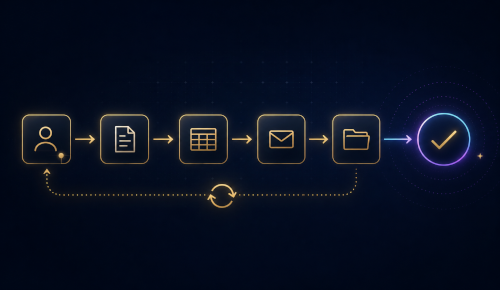
AI workflow example
A quick look at how a business task can become an AI-powered workflow.
Another practical AI example
AI can support intake, content, files, images, follow-up, reporting, and many other repeated tasks.
Overview

A short, practical course for the new AI workplace.

The goal is not to make every participant a programmer. The goal is to teach them how to notice business processes, break them down, and help turn them into useful automation.

๐Ÿ”Ž
Notice opportunities
Find repetitive tasks, delays, bottlenecks, missed follow-ups, manual reports, and process gaps.
๐Ÿงญ
Map workflows
Document inputs, steps, decisions, tools, owners, outputs, and automation opportunities.
โš™๏ธ
Coordinate implementation
Create simple prototypes or work with specialists to implement customized automations.

Participants learn by working from real business problems.

The program connects training to employer needs, so participants can speak clearly about business value, not just AI tools.

Portfolio-ready
Each participant should leave with a workflow map, automation plan, documentation, and estimated hours saved.
Workplace skill Business language Project evidence
Outcomes

What participants learn to do.

The training connects AI literacy, process thinking, automation tools, and practical communication.
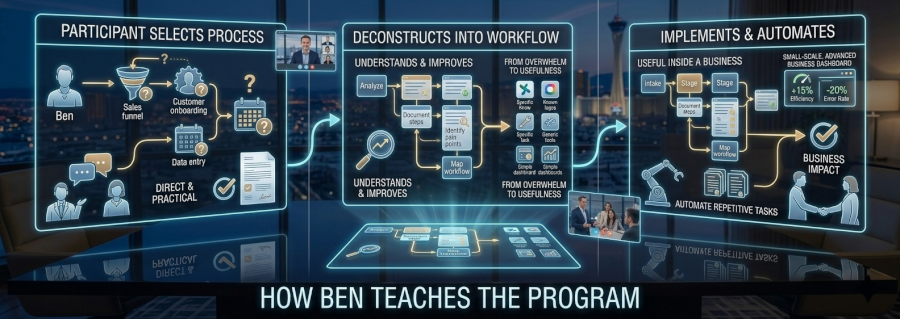
The 3 steps of the program to participants
Prompt AI for business use
Draft, summarize, classify, extract, organize, and improve workplace communication.
Interview a business user
Ask better questions, understand current process, and avoid guessing.
Build workflow logic
Understand triggers, actions, conditions, approvals, notifications, and exceptions.
Use no-code patterns
Work with forms, spreadsheets, email, calendars, CRMs, task systems, Zapier, Make, and n8n concepts.
Measure value
Explain hours saved, labor value, improved response time, and new revenue opportunities.
Present professionally
Show a before-and-after workflow and explain what should happen next.
Curriculum

Four-week structure.

Designed for working adults, current employees, new employees, and job seekers who need a practical skill without a long program.

Suggested rhythm: live instruction, practice labs, business examples, project work, and review.
1
AI and automation basics
Understand what AI is good for, what automation is good for, and where each fits in business operations.
2
Process discovery
Learn how to interview a business owner or employee and map how the work happens today.
3
Workflow design
Create cleaner before-and-after process maps with tools, steps, triggers, actions, and approvals.
4
Prototype and measure
Create a simple workflow plan or prototype, then estimate hours saved and business impact.
Example Projects

Example workflow projects.

The best projects are common business tasks that repeat often and can be explained clearly.

Lead follow-up
Customer intake
Appointment reminders
Missed call follow-up
Review requests
Hiring follow-up
Document collection
Weekly reports
Invoice reminders
CRM updates
Order tracking
Inventory alerts
Employee onboarding
Service requests
Internal handoff
Career Roles

Roles this prepares people for.

These are practical entry-level and internal business roles, not inflated titles.

AI Automation Specialist
Finds repetitive work, maps processes, coordinates simple automations, and supports adoption.
Process Automation Specialist
Focuses on business process improvement and no-code workflow design.
AI Workflow Coordinator
Connects business users, automation builders, and management around workflow implementation.
Internal AI Automation Champion
A current employee trained to spot opportunities and coordinate improvements from inside the business.

Questions about the participant track?

Contact Sharon Ben Kessous for course structure, employer-connected pilots, or workforce partner conversations.